

Following the announcement of 4 November 2026 as the date for South Africa’s next local government elections, the country has begun moving into the familiar noise and silliness of election season.
This is the period in which parties test messages, voters read the national mood through local frustrations, and social media becomes a battleground for claims, counterclaims, factional excitement and political mischief. In that environment, polling carries real weight, not only because it claims to measure public opinion, but because it can shape how voters, activists, journalists and parties understand political momentum.
That is why the images now spreading across social media under the names “LGE Research Foundation” and “Observant Network” deserve scrutiny. These graphics purport to show dramatic shifts in party support ahead of the 2026 local government elections, including claims that the EFF has grown to 27%, the DA has fallen to 12%, the Patriotic Alliance has surged to 20% in the Western Cape, and ActionSA has overtaken certain smaller parties in the Cape Metro. These are not small claims. They suggest major political realignment and are being presented in the visual language of formal polling, complete with party logos, percentages, charts and the branding of what appears to be a research body.

- The Fake National LGE Research Foundation and Observant Network Poll
The problem is that neither the so-called LGE Research Foundation nor the so-called Observant Network appears to exist in any credible public sense. There is no visible website, no contact number, no public research archive, no prior polling record, no published election work, no known researchers, no named directors, no institutional profile, no academic affiliation and no history of work in democracy, elections, governance or public opinion research. There is also no obvious registration trail for either entity as a company or non-profit body. These names do not appear to belong to recognisable institutions operating in the real world. They appear instead to function as labels placed on images to create the impression of authority.
That matters because a poll is not made credible by a random logo. A research foundation does not become real because its name appears at the bottom of a graphic. Public opinion research requires accountability. At the very least, a credible poll should disclose who conducted it, when it was conducted, where it was conducted, how many people were surveyed, how respondents were selected, what method was used, whether the sample was weighted, what the margin of error was, and whether the numbers refer to all adults, registered voters, likely voters, party supporters, a province, a municipality, a metro or the country as a whole. None of that is provided in the material being circulated.
What is being shared is therefore not polling in any serious sense. It is a set of numbers attached to invented or unverifiable institutional names. The figures are not presented as a random opinion from an anonymous account. They are presented as though they come from a research process. The names “LGE Research Foundation” and “Observant Network” give the graphics a veneer of legitimacy, allowing the fiction to travel with a borrowed seriousness it has not earned.
The figures themselves should also invite caution. The EFF rising to 27% nationally would be a major leap. The DA falling to 12% would represent a dramatic collapse. The Patriotic Alliance reaching 20% in the Western Cape would suggest a profound shift in provincial political behaviour. None of these things is impossible in the abstract, because South African politics is more fragmented than it was a decade ago and the 2024 election confirmed the weakening of old certainties. But serious shifts require serious evidence. They cannot be established through anonymous graphics from entities with no visible existence, no methodology and no record of credible polling.
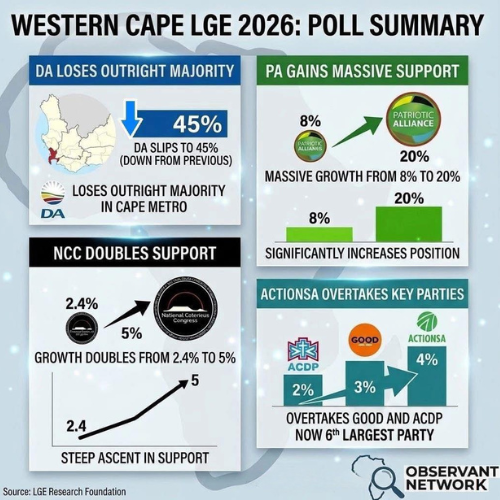
- The Fake Provincial LGE Research Foundation and Observant Network Poll
The issue is not whether parties can grow or decline. The DA can lose ground in some places. The EFF can gain ground in some places. The Patriotic Alliance can expand in areas where its message resonates. ActionSA, GOOD, the ACDP, the Freedom Front Plus, MK and other parties can all play meaningful roles in fragmented councils. Local government elections are often uneven and locally specific, with ward dynamics, turnout, candidate selection, service delivery failures and coalition reputations all influencing results. The issue is that the graphics being shared make sweeping claims without doing any of the work required to support them.
There is also something revealing about the construction of the images. They have the feel of AI generated political content: official-looking enough to circulate quickly, but thin once examined. The typography is uneven, the phrasing is awkward, the design is busy, and the presentation relies heavily on visual certainty rather than evidentiary substance. The format is well suited to the current social media environment, where an image can travel faster than a correction and where dramatic numbers are more likely to be reposted than methodological questions.
Political propaganda no longer needs to arrive as a long statement or formal campaign message. It can arrive as a screenshot. It can package a preferred narrative into a bar chart, attach a fake institutional name, and invite the public to absorb the conclusion before asking where the information came from. One party is made to look ascendant. Another is made to look finished. A third is presented as a kingmaker. A fourth is quietly pushed out of relevance. The purpose is not always to persuade through reason. Often, it is enough to create the feeling of momentum.
That feeling can influence behaviour. Supporters of a supposedly rising party may become more energised. Supporters of a supposedly collapsing party may become demoralised. Undecided voters may be nudged towards what appears to be the winning side. Party activists may use the numbers to push internal narratives. Social media accounts may use them to generate engagement. Commentators may be pulled into discussing false figures as though they form part of a legitimate electoral conversation. By the time the numbers are questioned, the narrative may already have done its work.
This is why fake polling cannot be dismissed as harmless online noise. Even legitimate polls can shape political expectations, affect media coverage, influence donor confidence and alter perceptions of viability. That is why proper polling must be scrutinised carefully. But there is a clear difference between a poll that can be debated and a fake poll that has no accountable institution behind it. The material circulating under the LGE Research Foundation and Observant Network names falls into the latter category.
The timing also matters. South Africa is heading into local government elections under conditions of severe public frustration. Municipal failure is no longer an abstract governance concern. It is visible in water interruptions, sewage spills, billing chaos, refuse collection failures, electricity problems, potholes, collapsing infrastructure and unstable councils. Voters are not merely choosing parties in the ordinary sense. In many communities, they are judging whether local government can still perform its most basic functions. That anger creates fertile ground for manipulation, because people are more likely to share claims that confirm their hopes, fears or frustrations.
The incentives on social media make the problem worse. Platforms such as X, Facebook and TikTok reward speed, novelty, outrage and emotional certainty. A fake poll claiming that one party is surging or another has collapsed is more shareable than a sober explanation of turnout patterns, ward-level performance, coalition arithmetic or survey methodology. Political actors and content monetisers understand this. A fabricated poll can serve party propaganda, social media engagement and personal monetisation at the same time.
It would be a mistake to assume that this necessarily requires a sophisticated operation. It may simply be the work of individuals with political sympathies, access to AI tools, a basic eye for viral content and no concern for the integrity of public debate. The barrier to producing convincing political fiction has collapsed. A person no longer needs institutional backing, fieldworkers, statisticians or a research budget to manufacture the appearance of polling. They need only a design tool, a set of plausible-looking numbers and the willingness to publish.
Voters, journalists and political observers should apply a basic test to any poll that appears on social media. The first question should not be whether the result feels politically pleasing or plausible. The first question should be whether the poll exists beyond the image. There should be a source document, a named organisation, a methodology, a sample size, a fieldwork period, a defined population, a geographic scope, a margin of error and a public way to verify the people or institution behind the work. If none of that exists, the material should be treated as propaganda, engagement bait or political fiction.
The LGE Research Foundation and Observant Network graphics are an early warning of the kind of election environment South Africa is entering. They show how easily fake authority can be manufactured, how quickly invented numbers can travel, and how vulnerable public debate becomes when institutional names are created to give anonymous content the appearance of research. As the 2026 local government elections approach, this will almost certainly intensify.
The 2026 election will be difficult enough without fabricated polling. Voters will have to judge parties on records, candidates, coalitions, municipal performance and the lived reality of local governance. Those choices should be shaped by evidence and political judgement, not by anonymous graphics carrying the names of entities that appear not to exist. The fake poll season has begun early, and the public should treat these so-called LGE Research Foundation and Observant Network claims with the caution they deserve.


